
On 10 November 2026, OpenAI launched “Businesses in ChatGPT” in beta. The programme has two parts: Business Hub, where businesses claim and manage their profile in ChatGPT, and Business Agent, an AI representative that talks to customers on the brand’s behalf inside ChatGPT. Business Hub is the first time an AI platform officially tells brands how often it mentions them. The interface is already live in local languages, including Turkish. Outside the US, however, claims currently land on a waitlist.
What is Businesses in ChatGPT?
Businesses in ChatGPT is an OpenAI programme that lets businesses verify and manage their profile in ChatGPT, measure their visibility in ChatGPT conversations and, in eligible markets, publish a branded AI agent. At its centre is Business Hub, available at chatgpt.com/business-hub.
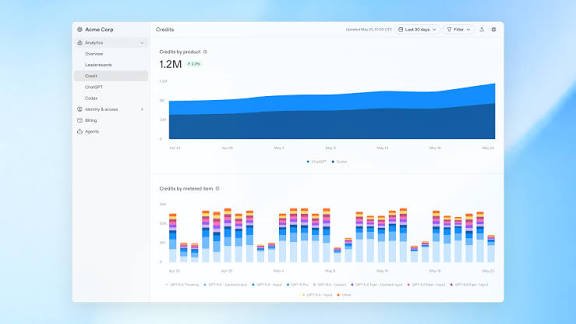
Watch the naming. ChatGPT Business is the paid subscription plan companies buy for their employees. Its admin console tracks internal usage, credit consumption and access rights. Businesses in ChatGPT is the listings programme that governs how a business appears to ChatGPT users. The two products belong to different teams: one to IT and operations, the other to marketing and sales.
Business Hub: profile, verification and visibility data
The claim must come from the business owner or an authorised representative. There are four ways to verify ownership: a business phone number, a company email address, a DNS TXT record on the website domain, or a Shopify store. Any one of them is enough to submit a claim. According to VentureBeat, approved claims then go through a separate identity check via Persona. Once verified, a business can update the core information ChatGPT uses about it, along with its product feeds. Claiming a profile requires neither an ads account nor an Enterprise agreement.
What the dashboard shows
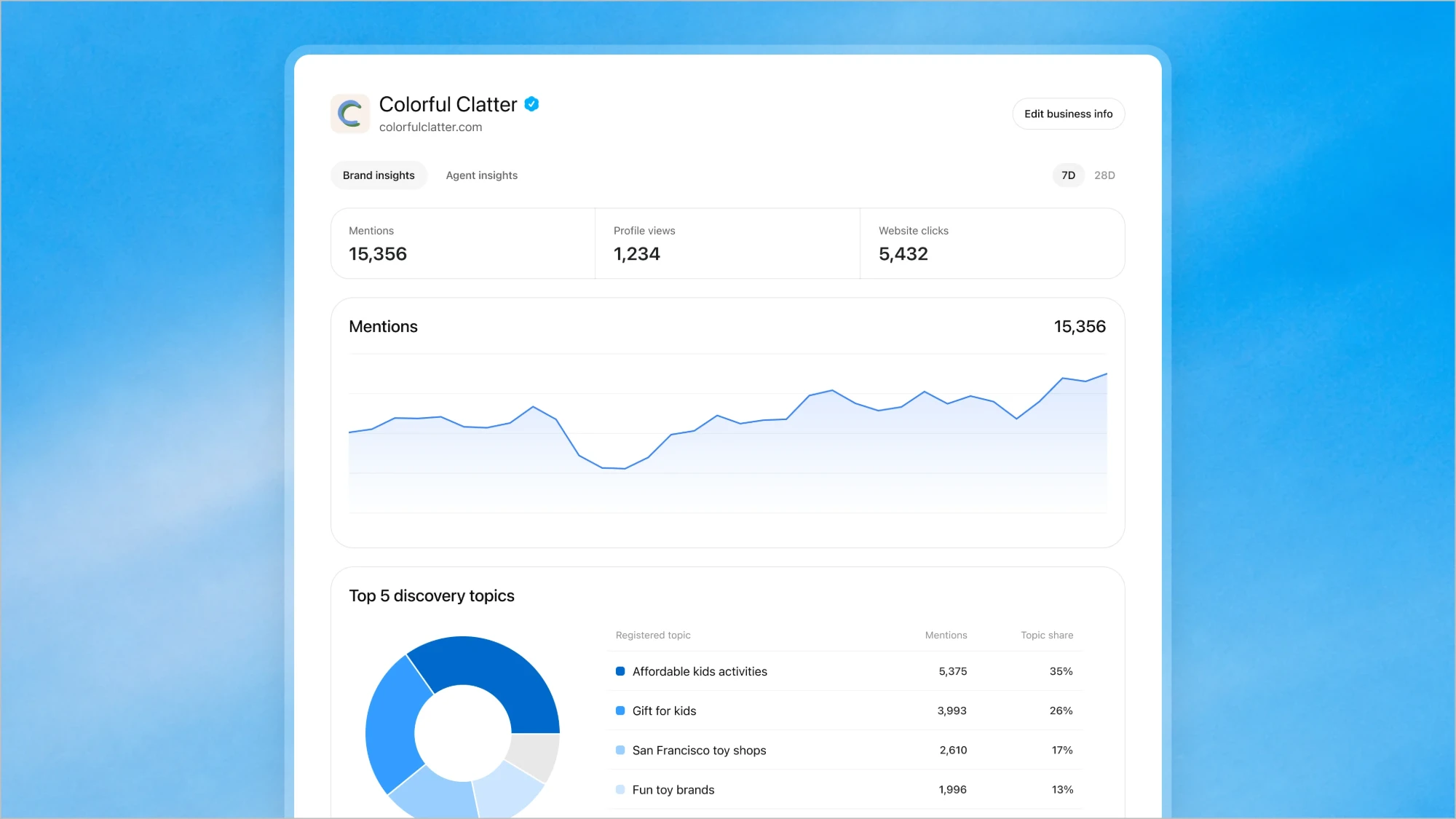
The dashboard has two tabs. The top of the Brand insights tab carries three figures: Mentions (appearances in ChatGPT answers), Profile views and Website clicks. Below them sit a mentions trend line and the top five “discovery topics”. Data can be viewed over 7-day and 28-day windows.
OpenAI defines discovery topics as recurring themes across conversations in which the business’s website is cited. The toy shop in the sample screen is most visible under “Affordable kids activities”, which accounts for 35% of its mentions. The Agent insights tab opens for businesses that have published a Business Agent.
Where the dashboard stops
- OpenAI does not share user conversations with businesses. Data is aggregated and appears only once conversation volume passes a threshold. The threshold has not been disclosed.
- According to one outlet, an OpenAI spokesperson said a brand name appearing on its own does not count as a mention, and a click is not a visit or a purchase.
- The dashboard has no prompt list, no competitor comparison and no ranking.
- Coverage is limited to ChatGPT. Gemini, Perplexity, Claude and Google AI Overviews fall outside this data.
- According to Benji Shomair, OpenAI’s VP of monetisation, claiming a profile does not change how often a business appears in ChatGPT. Complete information can, however, help a brand surface in more relevant conversations.
Business Agents: the brand’s representative inside ChatGPT
Eligible e-commerce and online service businesses in the US can build a branded AI agent inside ChatGPT, test it and publish it. The agent answers user questions using price and availability data from the product feed. Conversations with the agent are labelled and kept separate from the user’s regular ChatGPT chats. OpenAI does not share these conversations with the business either. Brands cannot connect agents they have built elsewhere.
The commercial model is already visible. Businesses can sponsor their Business Agent and use it as the destination for ChatGPT Ads campaigns. Sponsored placements are labelled, and ads appear only on the Free and Go plans. Speaking to Digiday, Shomair said Business Hub and the agents are free for now and did not rule out a paid model later. In short, Business Agent is the free, organic version of the sponsored agent format OpenAI began testing as a paid product in September.
Outside the US: the interface is live, claims are waitlisted
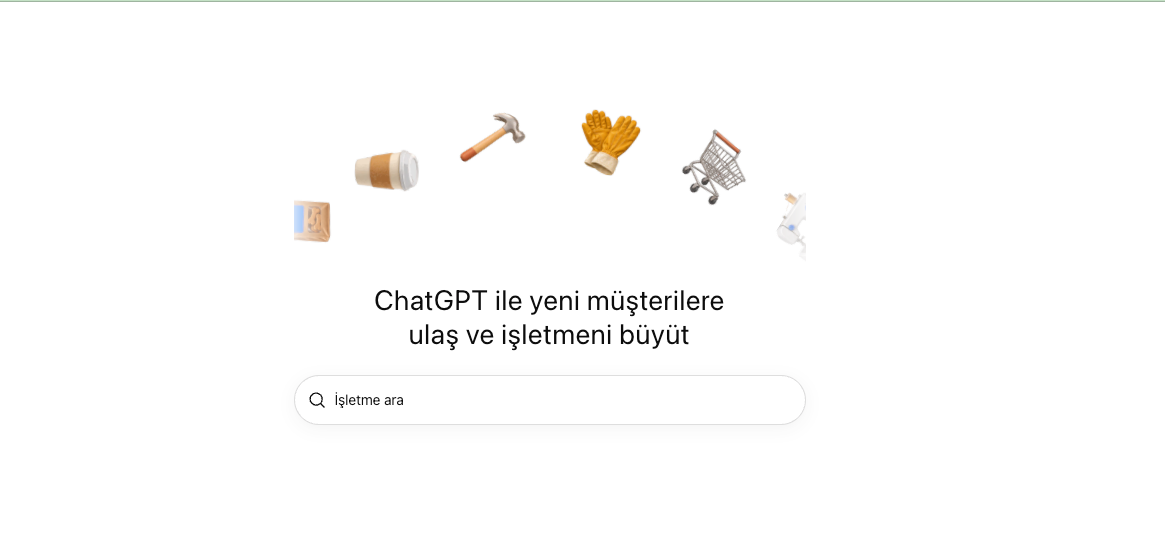
OpenAI’s announcement says Business Hub is open to eligible businesses in markets where ChatGPT is available. In practice, the beta is US-focused. Claims from Turkey stop at the “join the waitlist” step, and claims from India were reported to hit the same screen on launch day. Business Agent is open only to US businesses.
OpenAI has not announced dates for other markets. The official line is that the programme will expand “to more countries and business categories over time”.
When will it open? Our estimate
The closest precedent is OpenAI’s ads product. ChatGPT ads started testing in the US in February 2026 and opened to 31 European countries on 24 August. According to industry sources, Turkey was added to the self-serve Ads Manager list on 17 September, and the product reached 89 countries on 21 October. The move from the US to Turkey took roughly seven months.
The profile and visibility side of Business Hub touches neither payments, inventory nor consumer regulation, so it could spread faster than that. We expect profile claims and the visibility dashboard to open in markets such as Turkey in the first half of 2027. Business Agent, which ties directly into payment and consumer protection processes, is likely to follow later. This projection rests on the rollout pace of the ads product. OpenAI has published no official timeline.
What to do while you are on the waitlist
- Have the company owner or an authorised person join the waitlist with an email address on the company domain. A personal Gmail address may cause problems at verification.
- Prepare the verification set-up now: access to your DNS panel, a company email address and the business phone number listed on your website.
- Consolidate your company information on your website into one consistent source. Service definitions, categories, Organization and Product schema and clearly answered FAQ sections carry the most weight. Discovery topics are generated from conversations in which your site is cited. If ChatGPT has no page of yours to cite, the dashboard stays empty.
- Write down the decision questions you want to appear in. When the dashboard opens, this becomes the reference list you compare your discovery topics against.
What does it mean? Recro’s reading
AI visibility is now a metric the platform reports itself
By putting the “Mentions” counter at the top of the dashboard, OpenAI has turned a brand’s presence in ChatGPT answers into a measure as concrete as impressions in Search Console. Marketing teams will carry this number into management reports, and budget discussions will start from it.
The dashboard shows the outcome, not the cause
Business Hub tells you how many times you were mentioned. It does not tell you which question you were mentioned in, which competitor you were recommended alongside, how the answer described you, or which critical question you never appeared in. In a B2B buying decision, that detail is where the value lies. Being mentioned third as “the affordable option” for “Which agency should we use for our board presentation?” and being mentioned first as “the management-level specialist” go into the same counter.
The threshold works against B2B brands
Dashboard data appears only once conversation volume passes a threshold. B2B buying questions are low-volume, high-value questions. A niche industrial supplier, a consultancy or an enterprise software vendor may face an empty dashboard for a long time. Yet those few conversations are often the ones that decide the annual contract.
Claiming a profile does not raise visibility on its own
OpenAI says so explicitly. ChatGPT recommends a brand based on what it reads about that brand across the web: the website itself, trade publications, comparison content, LinkedIn and structured data. A verified profile is a layer added on top of these signals. If the signals are weak, the profile cannot close the gap.
A familiar model: free profile, paid prominence
A free profile paired with paid sponsored placement is ChatGPT’s version of the Google Business Profile and Google Ads pairing. On Google, businesses that set up their profiles early carried an advantage in local search for years. In ChatGPT, accurate representation and accumulated data will favour those who start early as well.
The gap period outside the US
Until the dashboard opens, brands outside the US have no official data on their ChatGPT visibility, and neither do their competitors. The way to use this period is to bring measurement forward through simulation. Recro’s AI Decision Visibility model runs your target customers’ persona-based decision questions through ChatGPT and other models, and reports which question you appear in, alongside which competitor, and in what words. Our B2B Focus Group Simulation shows how decision-makers actually phrase those questions. When Business Hub opens in your market, you will hold two layers: OpenAI’s counter and the decision map behind it.
Make AI reference you, not your competitors. In every question.
Measure your brand’s decision visibility in ChatGPT →
Frequently asked questions
What is ChatGPT Business Hub?
Business Hub is the business dashboard OpenAI launched in beta on 10 November 2026. Businesses use it to claim and verify their ChatGPT profile, update their information and track how often ChatGPT mentions them, how many people view their profile and how many click through to their website.
When will Business Hub open outside the US?
OpenAI has not announced dates. The interface is live in local languages, but claims from markets such as Turkey and India are routed to a waitlist. Based on the roughly seven months ChatGPT ads took to reach Turkey from the US, the dashboard could open in these markets in the first half of 2027. This is an estimate.
Is ChatGPT Business Hub paid?
Business Hub and Business Agent are currently free. OpenAI has not ruled out a paid model in future. Promoting a Business Agent as a sponsored placement is paid, through ChatGPT Ads.
Will claiming my profile make me appear more often in ChatGPT?
No. According to OpenAI, claiming a profile does not change how often a business appears. Visibility comes from what the web says about your brand and from your site being cited as a source. A complete profile helps ChatGPT describe your brand accurately in relevant conversations.
What data does Business Hub show?
The Brand insights tab shows mentions, profile views, website clicks, a mentions trend and the top five discovery topics over 7-day and 28-day windows. Conversation content, prompts and competitor data are not shared.
Is Business Agent available outside the US?
No. Business Agent is currently open only to eligible e-commerce and online service businesses in the US. OpenAI says it will expand to more markets but has given no dates.